The project
The MethaneMIP simulations
Motivation
It is unequivocal that significantly reducing methane emissions will slow global warming and its associated impacts over the coming decades. Considerable uncertainty remains, however, about the exact magnitude of near-term warming that could be avoided. Estimates of the climate benefits of methane mitigation derive largely from climate emulators, which are simplified representations of the climate system, and from a limited set of studies using comprehensive climate models.
We identified a pressing need for a coordinated intercomparison in which all modeling groups prescribe identical reductions in methane concentrations, use the same baseline scenario, and run enough ensemble members to investigate the broader climate and health impacts of methane mitigation. MethaneMIP was designed to undertake these tasks.
Research questions
MethaneMIP is organized around four primary questions.
- How much global and regional warming can methane mitigation avoid, and what are the associated uncertainty bounds?
- When will the response emerge from internal climate variability?
- How do interactive methane chemistry and natural source feedbacks alter the estimated climate benefit?
- What regional mortality and asthma benefits result from reductions in surface ozone?
Additional research opportunities
- Understand which climate events projected to occur by 2050 may be delayed or avoided by curbing methane emissions.
- Produce a multi-model estimate of the impacts of a Global Methane Pledge aligned pathway.
- Evaluate how prescribing methane emissions rather than concentrations influences the estimated impacts of mitigation.
- Explore how natural sources of methane may respond to methane mitigation.
- Further our fundamental understanding of how methane is simulated by Earth System Models, including its atmospheric lifetime.
- Diagnose the role of methane mitigation in overshoot scenarios in which climate targets are temporarily breached.
The MethaneMIP scenarios
The core MethaneMIP simulations use two methane mitigation scenarios: Technical Measures (TM) and Ambitious (TM+BC). Both cover the three decades from 2020 to 2050 and are used to explore the climate and health impacts of targeting methane reductions as a core part of global climate strategy, alongside their effects on air quality and vegetation.
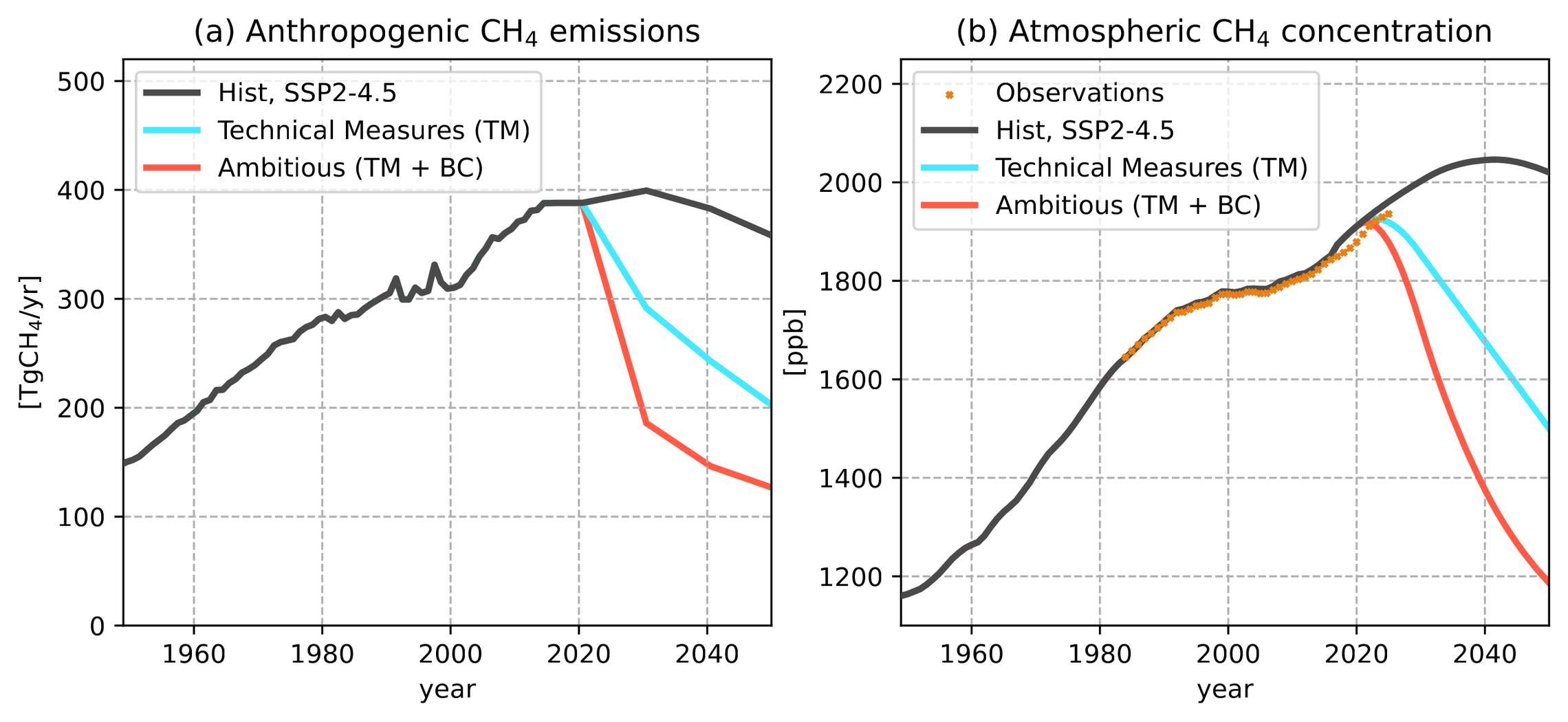
Scroll sideways to see both panels.
Technical Measures
TM
An implementation of the full range of technically feasible mitigation measures, many of them low or negative cost. This scenario is approximately aligned with the Global Methane Pledge: emissions in 2030 are 25% below 2020 levels.
By 2050 emissions fall to approximately 200 Tg CH4 per year, 44% below the reference scenario and 48% below 2020. The largest reductions are in the fossil fuel sector, which falls about 60% relative to the reference by 2050; agriculture, which is harder to address with technical measures alone, falls about 25%.
Atmospheric methane declines to roughly 1500 ppb by 2050, a concentration last seen in the early 1970s.
Ambitious
TM+BC
Technical Measures plus Behavioral Change. This scenario adds reductions from widespread behavioral change, most consequentially a sustained dietary shift toward less meat and dairy consumption, along with reduced food and household waste. Emissions in 2030 are nearly 50% below 2020 levels.
By 2050 emissions fall to about a third of their 2020 level, 65% below the reference scenario. Most of the difference from Technical Measures comes from agriculture, which falls a further 35% relative to the reference.
Atmospheric methane declines below 1200 ppb by 2050, a concentration last seen before 1960. The scenario is labeled ambitious, and is best read as an upper bound: achieving global behavioral change for climate mitigation is a considerable challenge.
Why SSP2-4.5 is the reference
SSP2-4.5 is broadly consistent with current emissions and legislative trends, reproduces the recent trajectory of observed methane reasonably well, and has extensive CMIP6 archive coverage, which limits the number of additional simulations required. Higher pathways such as SSP3-7.0 and SSP5-8.5 project methane emissions rising more than 40% above 2020 levels by 2050; measuring mitigation against those would inflate the apparent benefit. SSP2-4.5 is the more conservative benchmark.
Experiments
The core concentration driven experiments are requested from every participating model. The extended and emissions driven experiments are performed as model capability and computing resources allow.
| Experiment | Status | Period | Members per model |
|---|---|---|---|
| SSP2-4.5 reference, concentration driven | Core | 2015–2050 | 5–10 |
| Technical Measures, concentration driven | Core | 2020–2050 | 5–10 |
| Ambitious, concentration driven | Core | 2020–2050 | 5–10 |
| Extended subset | Optional | 2051–2070 | a few |
| SSP2-4.5 reference, emissions driven | Flagship | 2020–2050 | 3 or more |
| Technical Measures, emissions driven | Flagship | 2020–2050 | 3 or more |
| Ambitious, emissions driven | Flagship | 2020–2050 | 3 or more |
| Methane removal pulse | Flagship | 2019–2044 | 3 or more |
Scroll sideways to see every column.
Core, concentration driven
The mitigation runs branch from the corresponding SSP2-4.5 ensemble member at the start of 2020 and run to 2050, in the same fully coupled configuration each group used for its original CMIP6 SSP2-4.5 simulations. Only the methane pathway changes; carbon dioxide, aerosols and ozone depleting substances are identical.
Between five and ten members are requested per scenario, with ten encouraged. Two members are enough to detect the global-mean warming signal by mid-century in the Ambitious scenario, but at least five are needed for regional warming and Arctic summer sea ice. One lesson from AerChemMIP was that ensembles were too small to separate regional responses from internal variability.
Models without interactive atmospheric chemistry cannot produce the ozone response to methane mitigation, and would therefore understate the benefit. The experiments run in two stages: chemistry models go first, a multi-model ozone anomaly is derived from their results, and that anomaly is added to each non-chemistry model's own SSP2-4.5 ozone forcing.
Extended to 2070
The coupled system takes decades to adjust to a methane perturbation, so stopping at 2050 risks understating the full response. A subset of the core experiments is extended by twenty years, holding the 2050 level of mitigation rather than strengthening or relaxing it.
Flagship, emissions driven
Methane lifetime depends on methane's own abundance and on other reactive species, so prescribing concentrations suppresses the chemistry and climate feedbacks that matter. In the emissions driven runs, methane is prescribed as gridded, sector-resolved, monthly emission fields and atmospheric concentrations evolve prognostically. At least three modeling centers plan to contribute these.
Methane removal pulse
An idealized one-year removal of 170.1 Tg CH4 applied during 2019 and followed for a further 25 years, branched from the emissions driven reference. The magnitude is half the historical rise in anthropogenic emissions, comparable to the 2050 gap between the reference and Technical Measures. It isolates how an emissions perturbation propagates through methane burden, lifetime, radiative forcing and climate.
Current status, September 2026
- The experimental design and scenario forcing datasets are complete.
- Four models have completed the concentration driven core experiments, comprising 25 ensemble members.
- Three modeling centers have committed to paired emissions driven experiments.
- Additional simulations, data harmonization and multi-model analysis are underway.
- The MethaneMIP protocol paper is in preparation for submission to Geoscientific Model Development.
Next steps
- Complete and harmonize the remaining core simulations.
- Quantify avoided warming and associated uncertainty.
- Determine when climate responses emerge from internal variability.
- Assess the effects of interactive methane chemistry and natural source feedbacks.
- Estimate regional health benefits from reductions in surface ozone.
- Release harmonized data, code and research outputs publicly.