Learn about methane
Where do methane emissions come from?
Approximately 60% of methane emissions are due to human activity, mostly from fossil fuels, waste and agriculture. The remaining 40% comes from natural sources.
Emissions from human activities
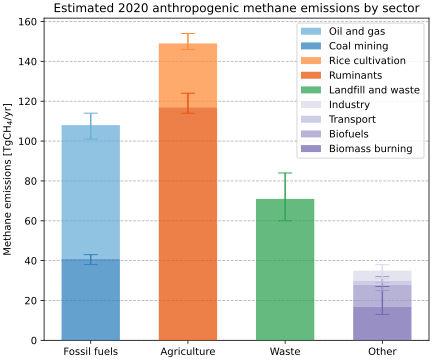
Scroll sideways to see the whole chart.
Fossil fuels
The fossil fuel sector emits methane at several stages of extraction, processing and distribution.
- Extraction. During the drilling of oil and natural gas wells, methane can leak from equipment, seals and other infrastructure. This is especially common in older fields and where maintenance is difficult.
- Processing and storage. Natural gas is primarily methane. Inadequate or faulty equipment leads to leaks and to unintended venting.
- Transportation. Methane is moved through pipelines and storage facilities, where damage, corrosion or poor maintenance causes leaks.
Coal combustion itself does not produce methane, but mining can be a significant source.
- Underground coal mining. Coal seams naturally contain methane, which is released when coal is mined unless it is captured.
- Coal bed methane. Methane trapped within coal deposits is sometimes captured as a byproduct for energy, and otherwise escapes.
- Ventilation in mines. Inadequate ventilation or outdated gas capture systems result in significant leakage.
Agriculture
The agricultural sector is a significant source of methane, from several activities.
- Enteric fermentation. Ruminant animals such as cattle, sheep and goats produce methane during digestion, released primarily through belching rather than flatulence.
- Manure management. Manure stored or treated with limited oxygen, for example in anaerobic lagoons or storage pits, generates methane as it decomposes.
- Rice cultivation. Flooded rice paddies create the anaerobic conditions in which methanogenic bacteria produce methane.
- Other agricultural practices. Decaying crop residues and soil organic matter contribute under some conditions, though less than livestock and rice.
Waste
The waste and wastewater sector emits methane primarily through the anaerobic decomposition of organic matter.
- Landfills. Organic waste such as food scraps, paper and yard waste breaks down under low-oxygen conditions and produces methane. Many landfills now have gas capture systems, but not all emissions are contained.
- Open dump landfills. Where waste management is less regulated, open dumps without covering or gas collection release methane directly to the atmosphere.
- Wastewater treatment. Organic material decomposes and releases methane during sewage treatment, particularly in anaerobic digesters and sludge treatment ponds. Some facilities capture this methane for energy.
Natural emissions
A substantial portion of total methane emissions, approximately 40%, comes from natural sources. The three main natural sources in the present climate system are wetlands, including bogs, marshes, peatlands and swamps, freshwaters, and geological outgassing, including gas and oil seeps, volcanoes and microseepage.
Methane is mainly removed from the air by oxidation, a natural cleaning process in the lower atmosphere. This process depends on the amounts of methane and other gases present. When a great deal of methane is released, the air's capacity to clean itself slows, and methane stays in the atmosphere longer.
Natural sources such as wetlands and thawing permafrost can release more methane as the planet warms, which blurs the distinction between natural and human-caused methane sources.
When researchers project how the climate will change, they have to make judgements about how emissions of different gases, including methane, will evolve. The standard approach is to assume that natural methane emissions stay constant as the world warms, in part because of the substantial uncertainty in how they will change. If natural methane emissions increase under climate change, then future warming from methane may be underestimated. There is evidence that some of the recent rapid rise in atmospheric methane concentrations was fueled by wetland emissions (Oh et al., 2022; Peng et al., 2022; Qu et al., 2022; Shindell et al., 2024).
References
- Oh, Y., Zhuang, Q., Welp, L. R., Liu, L., Lan, X., Basu, S., Dlugokencky, E. J., Bruhwiler, L., Miller, J. B., Michel, S., Schwietzke, S., Tans, P. P., Ciais, P., and Chanton, J. P.: Improved global wetland carbon isotopic signatures support post-2006 microbial methane emission increase, Communications Earth and Environment, 3, doi:10.1038/s43247-022-00488-5, 2022.
- Peng, S., Lin, X., Thompson, R. L., Xi, Y., Liu, G., Hauglustaine, D., Lan, X., Poulter, B., Ramonet, M., Saunois, M., Yin, Y., Zhang, Z., Zheng, B., and Ciais, P.: Wetland emission and atmospheric sink changes explain methane growth in 2020, Nature, 612, 477–482, doi:10.1038/s41586-022-05447-w, 2022.
- Qu, Z., Jacob, D., Zhang, Y., Shen, L., Varon, D. J., Lu, X., Scarpelli, T. R., Bloom, A. A., Worden, J., and Parker, R. J.: Attribution of the 2020 surge in atmospheric methane by inverse analysis of GOSAT observations, Environmental Research Letters, 17, 094003, doi:10.1088/1748-9326/ac8754, 2022.
- Shindell, D., Sadavarte, P., Aben, I., et al.: The methane imperative, Frontiers in Science, 2, doi:10.3389/fsci.2024.1349770, 2024.